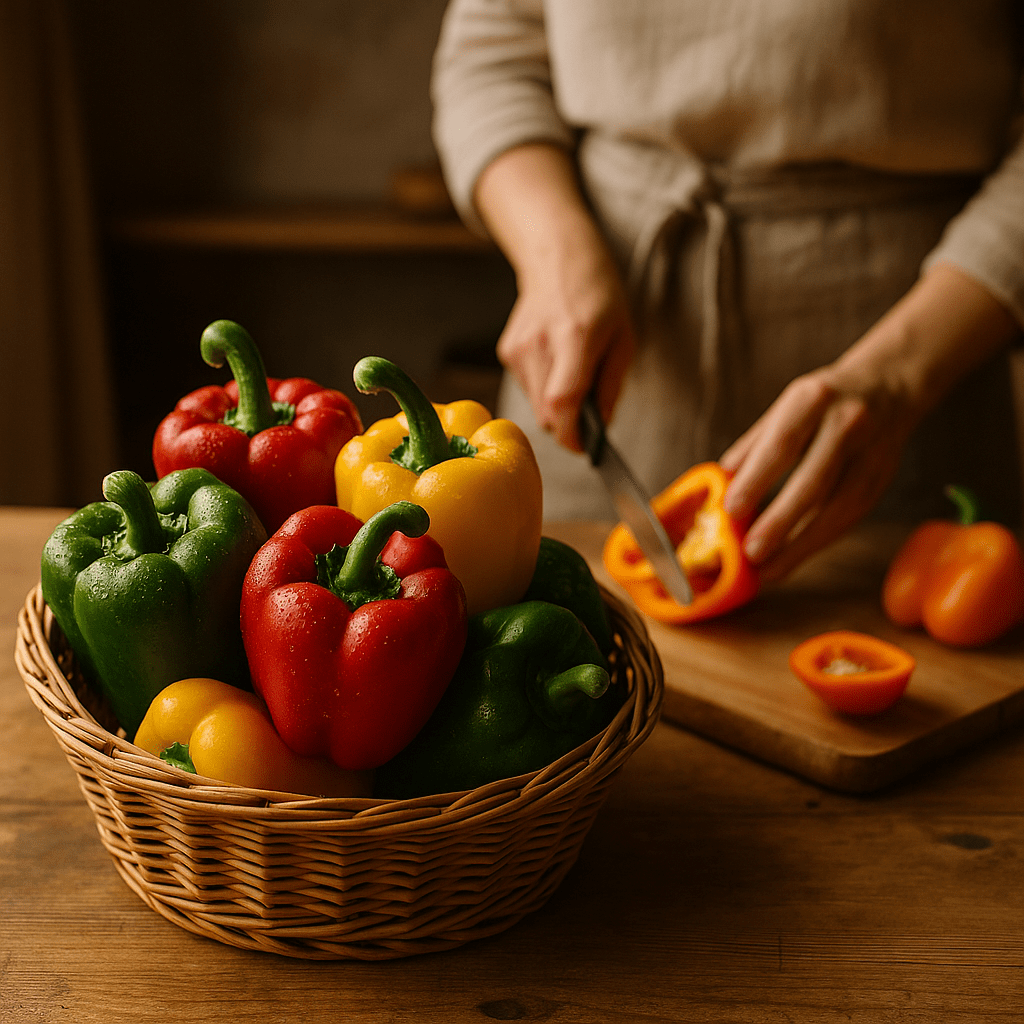
Peppers make me sick.
For as long as I can remember, every time I eat them I end up with a stomach burn that can ruin my whole day. My mother—bless her soul—loved peppers. She grew them in her garden and, when they were out of season, she always had them ready in the freezer, cleaned and stored. She would often prepare them for me, convinced she was doing me a favor:
“I’ve peeled them, taken off all the skin—that’s what makes you sick! With good olive oil, you’ll see how delicious they are, and they won’t hurt you!”
To make her happy, I’d taste a bit. And, sure enough, after just a few minutes, the burning would arrive, as punctual as a clock.
I remember a family lunch when my nephew, after yet another refusal of peppers, asked me:
“But Aunt, you’re a nutritionist—haven’t you ever wondered why they make you sick?”
No. I’m not interested. Because even if I discovered the reason, the reality wouldn’t change: I can’t eat peppers. Period. There’s no need to know if it’s because of a particular molecule or some physiological mechanism. My body gives me a clear signal, and I listen to it.
This simple, almost trivial experience contains a concept that seems forgotten today: personal experience is already a form of knowledge. That’s how it used to be. If a food made you sick, you avoided it. Without tests, without endless debates, without asking a nutritionist for the scientific validation of what your stomach was already telling you.
My Colleague’s Rice (and the Public’s Distrust)
A few days ago, a fellow nutritionist posted a short reel on YouTube:
“Here’s why I don’t eat rice and never will.”
He listed well-known, accurate reasons: high in starch, high glycemic index, blood sugar spikes… and even the presence of arsenic.
All correct, to be clear. Rice is not a food we should overdo. But the problem is not the content of the message—it’s the context.
The comments under the video were full of doubts and distrust:
- “Wait, another nutritionist says rice is fine as long as it’s whole grain…”
- “In Japan they live on rice and are long-lived, so?”
- “Yes, there’s arsenic in rice, but I’ve seen it’s also in many other foods… so should we stop eating altogether?”
The point is, you can’t explain a complex topic like the impact of rice on health in a one-and-a-half-minute reel. There’s no space to say that it depends on the amount, the frequency, the way it’s cooked, and the dietary context in which you eat it. And so, inevitably, the message is reduced to a “yes” or “no,” feeding the very mentality that’s doing us more harm than rice itself.
The Dictatorship of Yes and No Foods
We live immersed in a fragmented food culture, full of mental lists: this you can eat, this you can’t, this only sometimes. It’s become almost a kind of food math: an algorithm for building the “perfect” diet.
Only, the human body is not an algorithm.
Until very recently, eating was a natural, instinctive phenomenon. People ate what nature offered, in the right season, in the right place. Every population was adapted to the foods of its own territory. And within this general framework, each person adapted to themselves: if you couldn’t digest a food, you avoided it; if you didn’t like it, you left it on the plate. That was it.
Today, instead, it feels like we need written permission for every bite. Are we sure that’s the right way?
We’ve lost the sense of the big picture: understanding how food works in our body, instead of obsessively focusing on the detail of arsenic in rice or the skin on a pepper.
It’s Not (Just) About Nutrients
Of course, there are foods with objective drawbacks for everyone, not just personal ones. But even then, it’s not about demonizing them.
A food is not “good” or “bad” in absolute terms: it depends on how much, how, and when you eat it. Lard, for example, is not pure poison, but it’s also not a breakfast-lunch-dinner food. The issue is not the single food—it’s the frequency and the context.
The job of a nutritionist today shouldn’t be to hand out yes/no food lists, but to help people read their plate with a clear mental map, one that can guide sensible, sustainable choices. It’s not about memorizing every single molecule, but about reasoning in categories and general principles.
Why I’m a Rebel Nutritionist
I call myself that because I rebel against an idea of eating that creates anxiety, confusion, and distrust.
I don’t want to be the professional who adds another brick to the wall of prohibitions, but the one who helps people reclaim food with peace of mind.
My goal is to create a real food culture: to teach people to observe food from above, to understand the effect it has on our bodies, to return to eating without paranoia.
My “Mini University of Nutrition”
I envision a program, both online and in person, for those who really want to understand what it means to nourish themselves today. A sort of “mini degree” for non-professionals, made up of meetings, courses, discussions.
Not to memorize nutritional tables, but to return to a healthy, natural relationship with food.
A place—both real and virtual—where you can shed the weight of food fads and discover how to eat well without stress, without extremism, without lists of prohibitions. It’s my dream, and I’ll soon try to make it a reality.
Because food is not a multiple-choice quiz.
It’s part of our life, our culture, our well-being.
And my work, as the rebel nutritionist, is to help you remember that.

 RIVOLUZIONE ALIMENTARE