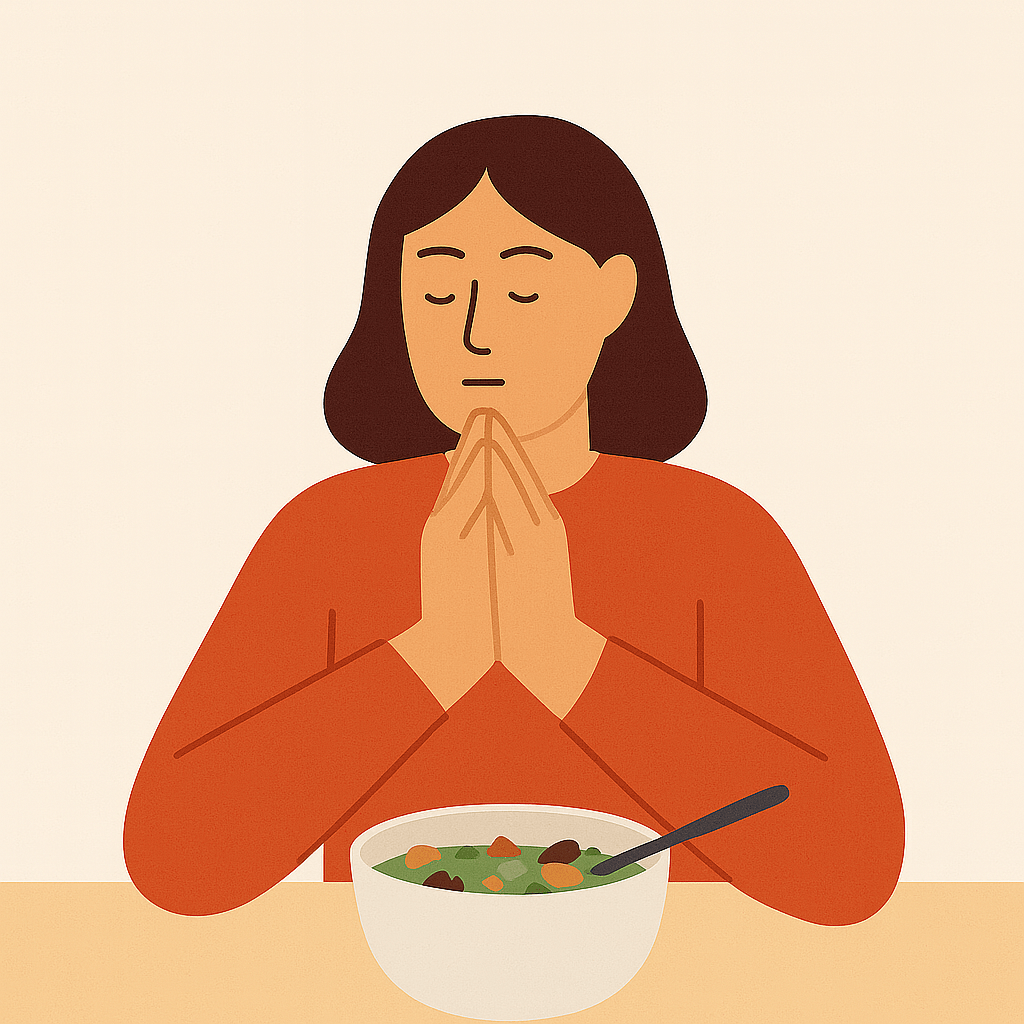
“Slow food” should be about returning to the prayer of thanksgiving before eating: thank you for the food I’m about to eat, thank you because this food isn’t here by chance.
After my consultation, a patient wrote a wonderful review on my professional website, signing herself “family…” (I’m obviously omitting her last name for privacy reasons).
The woman had actually come with her teenage daughter, with the goal of focusing on proper nutrition, especially for the benefit of the girl who, like all young women today, is very confused about food, torn between a diet designed to encourage weight gain and their desire to be as thin as a sylph.
Well, if there’s anything that deeply gratifies me as a professional, it’s that “family…”.
First of all, I want to emphasize that family does exist, indeed. From my vantage point, I see it in all its new facets: lights and shadows, various difficulties, with spouses, children, schedules, money, elderly caretakers…
It’s a family that’s sometimes a bit fragmented, or extended, or small, often chaotic, but I always see the eyes of mothers and fathers shine when they talk to me about their children, even when they complain about them.
And often, very often, I see in the kids that look of defiance and submission, that feigned boredom, “Come on, Mom, don’t be a pain,” or a slightly embarrassed “Mom, what are you talking about…” and that uncertainty (where’s all that infamous bravado we talk about?), that innocence in the face of a life yet to be lived.
And I want to say that I like working with families. I love it when mothers and children arrive, when fathers and mothers arrive, or engaged couples, or newlyweds, or long-term spouses who now have more time and want to enjoy themselves and their children and grandchildren.
I love listening to their stories, I love sensing that web of affection that gradually emerges, and above all, I love being able to put my professionalism at their disposal.
Yes, because food, the act of eating, is a social fact, but above all a family one, and requires “wisdom.”
What is wisdom? Not the kind learned from school. Wisdom is something more. It’s combining information with understanding and the ability to implement it. Knowing, understanding, acting.
It’s a typically feminine value: much of the world’s wisdom has been passed down by women around the hearth. Once upon a time, women “knew” the function of food. Today, information comes to us from “Mulino Bianco”, but Barilla doesn’t produce real food.
Eating is nourishment: of the body, the spirit, the heart, relationships, love. Eating is care, pleasure, participation, sharing, culture, expression, friendship, trust, exchange… it is tradition and integration. Eating is forgiveness, it is offering, it is acceptance; it is patience and waiting. Eating is also meditation.
But if we want our children to stop eating takeout and junk food, we must teach them all this. We must understand what food is and what it isn’t, and what value it has in our lives. And how it changes our lives.
Because, as we know, we are what we eat, because food shapes our bodies but above all, strange as it may seem, it shapes our minds: it modulates hormones and neurotransmitters, and changes our mood.
“Slow food” should be something deeper than the pretentious tasting of rare and precious gastronomic delicacies. Slow food should be an attitude, an ability to eat simple, authentic foods, every day; it should be finding the time to prepare food, which sometimes takes just 10 minutes, less than finding parking in front of the restaurant. Slow food should be about not taking food for granted, about asking ourselves what suffering, labor, exploitation, danger, and disease lie behind that slice of prosciutto, and about what future holds for the environment.
Slow food should be about returning to the prayer of thanksgiving before eating: thank you for the food I’m about to eat, thank you because this food isn’t here by chance.

 RIVOLUZIONE ALIMENTARE